
This project was completed as part of the 2026 Hampshire Hospitals NHS FT Green Team Competition.
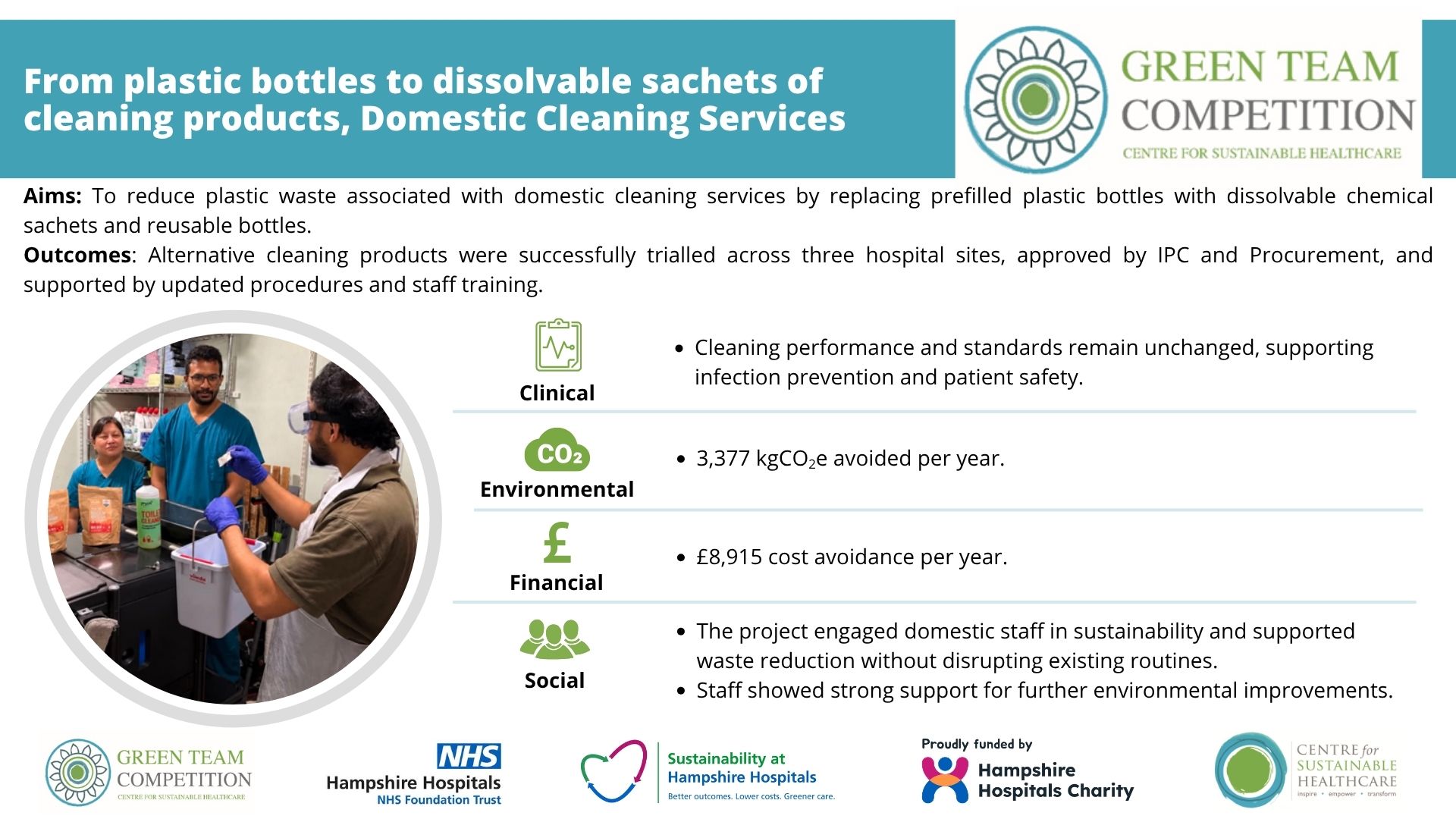
Team members
- Paul Norris, DOSM
- Emmajane Todua, DOSM
Setting / patient group
This project was undertaken within Domestic Services across the three sites of Hampshire Hospitals NHS Foundation Trust. The service provides routine cleaning and decontamination activities in clinical and non-clinical environments that support the care of patients of all ages and clinical needs. Approximately 14,000 cleaning product bottles are used annually across the Trust.
Issue
Domestic Services identified cleaning products as a high-volume consumable associated with substantial plastic waste, carbon emissions and procurement costs. Three commonly used cleaning products, R6 limescale remover, Hospec liquid detergent and toilet cleaner, were supplied in single-use HDPE plastic bottles, generating approximately 950.8 kg of plastic waste annually. Review of annual purchasing data identified the service as an outlier for both cost and waste, prompting investigation of more sustainable alternatives.
Intervention
The project proposed replacing prefilled plastic cleaning bottles with dissolvable cleaning sachets and reusable bottles. Alternative products were reviewed and trialled across all three hospital sites in non-clinical areas. Product testing assessed cleaning performance, ease of use and staff satisfaction. Following successful trials, the new products were reviewed and approved by Infection Prevention and Control (IPC) and Procurement teams. Standard operating procedures, COSHH documentation and staff training materials were updated to support implementation. The trial was delivered without additional financial investment and was cost-neutral to implement.
Potential Outcomes
Clinical
No adverse impact on patient care is anticipated. Cleaning performance remained unchanged during the trial, with replacement products providing equivalent functionality to existing products. The project demonstrated that environmental and financial improvements could be achieved while maintaining safe and effective environmental hygiene standards and supporting infection prevention requirements. Measuring changes in infection rates was outside the scope of the project.
Environmental
The current system generated an estimated 3,599 kgCO₂e annually from plastic bottle production, disposal and transport. The proposed sachet-based system was estimated to generate 221.6 kgCO₂e annually, resulting in a projected annual carbon reduction of 3,377 kgCO₂e. Annual waste generation would decrease from 950.76 kg of HDPE plastic bottles to 92.53 kg of mainly paper-based packaging, representing a reduction of 858.23 kg of waste per year. Transport emissions would also fall substantially due to lower product weight and a shorter supplier-to-hospital distance
Financial
The existing cleaning products cost £14,605 per year, including procurement and waste disposal costs. The proposed sachet system would cost £5,689 annually, generating projected annual savings of + No significant capital investment was required because reusable bottles were inexpensive and incorporated into routine procurement processes.
Social
Staff feedback demonstrated strong support for sustainability initiatives and identified opportunities for further environmental improvements. Staff highlighted reducing paper use, reducing disposable items and plastic use, improving recycling practices, increasing use of environmentally friendly products and expanding sustainability education as priorities. The project also reduced storage pressures and waste handling requirements while enabling staff to participate in a visible sustainability initiative aligned with NHS values. Budget constraints and resource availability were identified as the main barriers to further progress.
Key learning point
The project demonstrated that routine cleaning products can have a significant cumulative environmental impact when used at scale. The discussion highlighted that the greatest environmental benefit came from eliminating single-use HDPE bottles, with additional benefits from reduced transportation and waste disposal. Key barriers included staff familiarity with existing products, ensuring consistent dilution processes and management of reusable bottles, but these could be addressed through training, standard operating procedures and ongoing monitoring. The team also concluded that the methodology could be applied to other consumables where disposable packaging is a major contributor to environmental impact
 Download resource -
Please log in or sign up to comment.