
Project completed as part of the University Hospitals of Northampton Green Team Competition.
Team members
Samantha Chatwin Quality Manager, Robert White Deputy Lead of Radiology
Setting / patent group:
Radiology services, focusing on patients referred for CT Colonography (CTC) and on staff using radiology computer and imaging equipment.
Issue:
Two sustainability challenges were identified:
1. CTC Pathway: Patients were required to make an additional hospital visit to collect bowel preparation, resulting in unnecessary travel, increased emissions, inconvenience for predominantly elderly patients, and delays in the lower GI diagnostic pathway.
2. Energy Use: Radiology is one of the most energy intensive departments. Computers, monitors, and CT/MRI scanners were consuming large amounts of -intensive departments. Computers, monitors, and CT/MRI scanners were consuming large amounts of electricity, especially during idle times, contributing significantly to carbon emissions and operational costs.
3.
Intervention:
CTC Pathway Change:
A redesigned pathway allowed bowel preparation to be given at the point of referral, eliminating the need for a second trip. Posting prep remained an option for virtual appointments. Collaboration included outpatients, endoscopy, pharmacy, and radiology booking teams.
Energy Project:
Working with IT, the team audited workstation energy use and implemented sleep mode power settings on computers, reducing idle time-time energy consumption.
Outcomes:
Clinical:
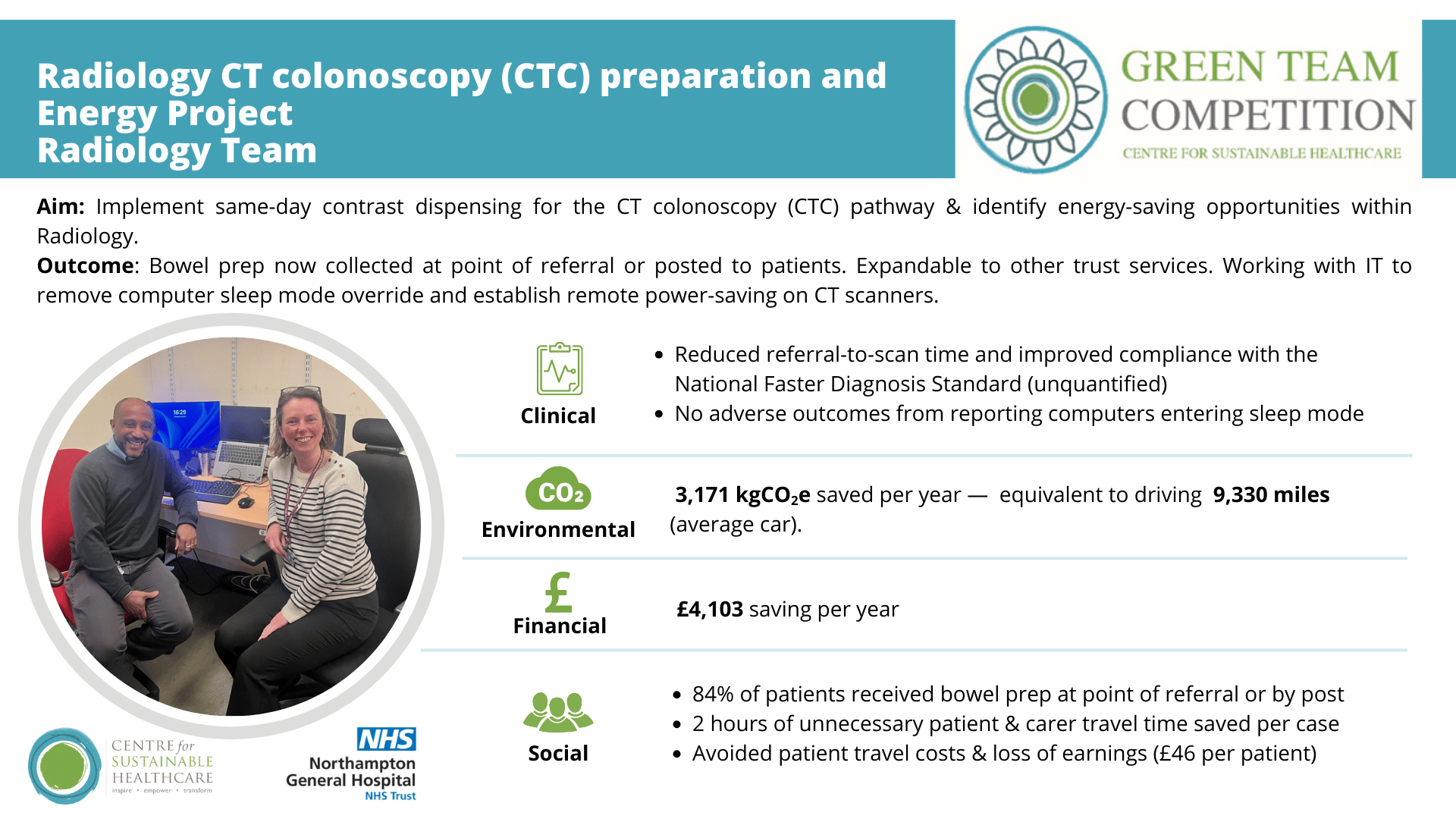
Transitioning to issuing CTC bowel preparation at the point of referral, led to a 70% reduction in patients needing to return to the hospital for prep collection. Post project 84% of patients either collected their bowel prep at the point of referral or it was posted to them. This helped improve the referral to-to scan turnaround time and supported compliance with the national Faster Diagnostic Standard. Importantly, introducing sleep mode-mode energy settings on radiology computers had no negative impact on clinical workflow or patient outcomes.
Environmental:
The redesigned CTC pathway reduced yearly carbon emissions by 1,948.7 kgCO₂e, primarily due to avoiding unnecessary patient travel. Introducing computer sleep mode settings in Radiology created a modelled saving of up to 1,222.5 kgCO₂e per year. Combined, the two projects achieved an overall environmental reduction of 3,171 kgCO₂e annually, which is equivalent to 9,329 miles driven in an average car.
Financial:
By eliminating separate CTC preparation appointments, the Radiology department saved £3,033 per year in radiographer time. Implementing computer energy saving measures reduced electricity usage by 5,876.5 kWh annually, resulting in a further £1,069 in financial savings. Collectively, the two projects produced a yearly saving of £4,103.
Social:
Patients benefitted socially by avoiding unnecessary travel, fuel costs, parking fees, and long waiting times. Each patient was estimated to save £46 when accounting for travel costs and potential loss of earnings for themselves or their carers. This change particularly supported elderly patients, many of whom rely on others for transport. The energy saving project did not have any negative social impacts. Issuing the preparation at the point of referral saved 117 hours of staff time per year. This efficiency allowed staff to redirect their time to higher‑value workload activities.
Key learning points:
Strong cross department collaboration was essential to success. Early staff engagement and alignment with organisational sustainability and Faster Diagnostics goals helped embed changes.
Simple interventions like pathway redesign and computer sleep mode optimisation, delivered significant environmental and financial benefits with minimal disruption to workflow
 Download resource -
Please log in or sign up to comment.