
This project was undertaken at Warszawski Uniwersytet Medyczny Hospital as part of the KitNewCare project.
Team members
Zuzanna Jakubowska1
Małgorzata Kępska Dzilińska1
Ewa Wojtaszek1
Jolanta Małyszko1
Paweł Żebrowski1
Urszula Jabłońska2
Jarosław Gopek3
1 physician, nephrologist
2 nurse
3 administrative worker / finance professional
Life Cycle Assessment Support
Life Cycle Assessments were conducted by Dr James Larkin, Postdoctoral Researcher and Sustainability Officer at Trinity College Dublin.
Setting/ patient group
The optimization was implemented in the dialysis department of a university hospital. The unit occasionally provides care for approximately 20 peritoneal dialysis patients, primarily in emergency situations such as peritonitis, while their chronic treatment is conducted at home.
Issue
In the dialysis unit, four fluid heaters have been continuously operating as a result of the room organization, which divided the treatment space into two separate sections. While this arrangement ensured convenient access, it also led to the unnecessary use of four devices at the same time.
Intervention
A structured action plan was developed to support implementation. Baseline electricity consumption of the heater was measured using a plug-in energy meter, and approval for the change was obtained from department leadership. Staff were informed of the revised workflow, with one heater designated for routine use and the second retained for emergency backup. Clear guidance on heater use was provided, and electricity consumption and staff feedback were monitored following implementation to evaluate the impact of the change.
Outcomes
Patient
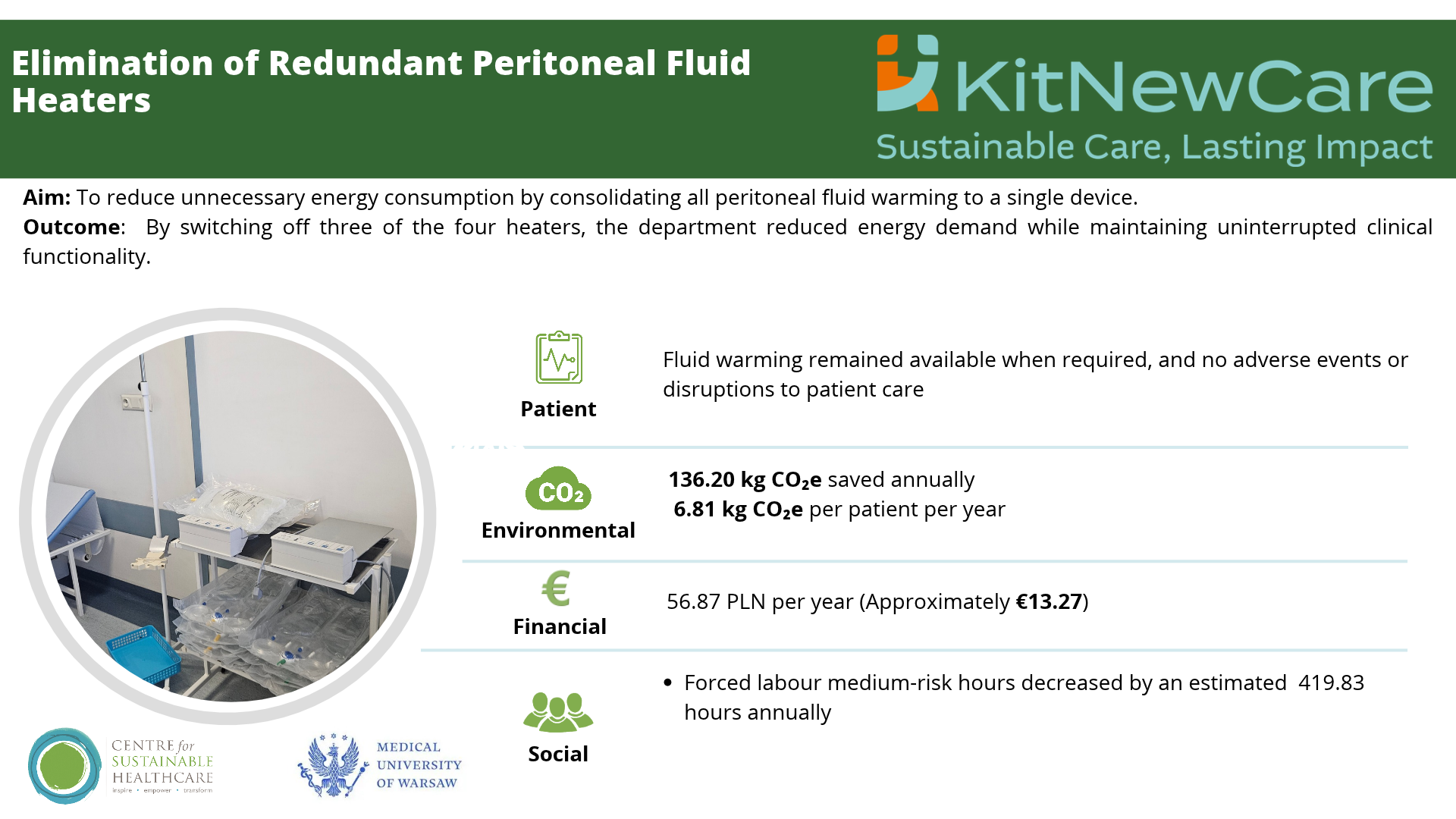
No safety risks were observed following implementation. Fluid warming remained available when required, and no adverse events or disruptions to patient care were reported during the observation period.
Environmental
Removal of three heaters from routine use saved an estimated 197.1 kWh of electricity per year, reducing carbon emissions by approximately 136.2 kg CO₂e annually (6.81 kg CO₂e per patient per year). The change also reduced water deprivation impacts by an estimated 42.13 m³ world-equivalent annually, or 2.11 m³ per patient per year.
Economic
The reduction in electricity consumption resulted in lower energy-related costs. Estimated cost savings were 56.87 PLN per year (€13.27).
Social
There was an estimated reduction of 419.83 forced labour medium-risk hours per year, or 21 forced labour medium-risk hours per patient per year.
Summary
This project demonstrates that small operational changes can deliver measurable sustainability benefits without affecting patient safety or workflow. Consolidating fluid warming to a single device reduced energy consumption while maintaining clinical flexibility through the availability of backup heaters.
 Download resource -
Please log in or sign up to comment.