
This project was undertaken at Warszawski Uniwersytet Medyczny Hospital as part of the KitNewCare project.
Team members
Zuzanna Jakubowska1
Małgorzata Kępska Dzilińska1
Ewa Wojtaszek1
Jolanta Małyszko1
Paweł Żebrowski1
Urszula Jabłońska2
Jarosław Gopek3
1 physician, nephrologist
2 nurse
3 administrative worker / finance professional
Life Cycle Assessment Support
Life Cycle Assessments were conducted by Dr James Larkin, Postdoctoral Researcher and Sustainability Officer at Trinity College Dublin.
Setting/ patient group
The dialysis station serves approximately 90 patients, generating a significant amount of medical and general waste. Additionally, the nephrology department operates at a scale of 1,000 patient-days per month, necessitating an efficient and sustainable waste management system.
The following waste streams were identified as available under the waste contract:
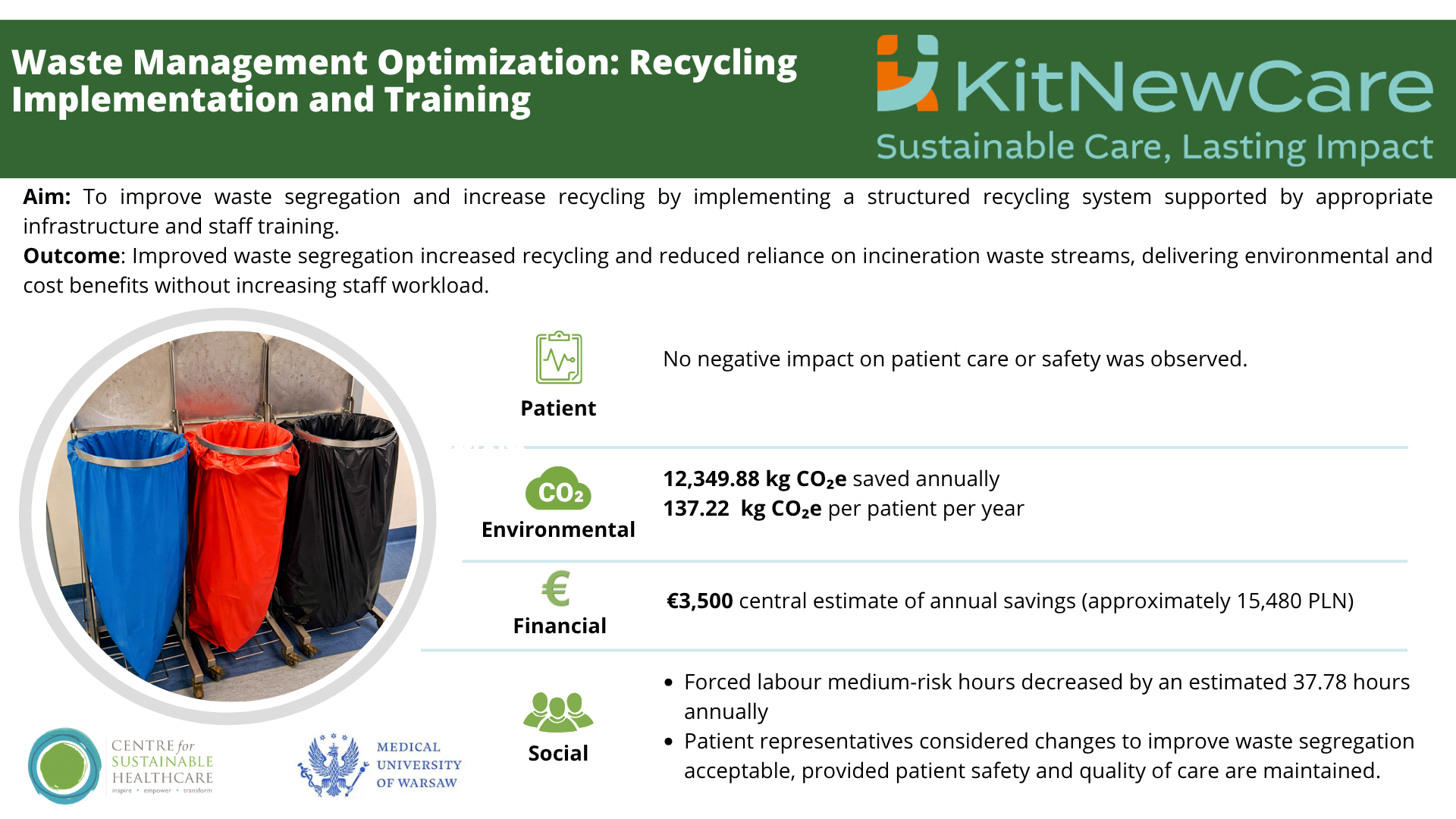
Infectious medical waste (red bags, incineration), non-infectious medical waste (blue bags, municipal treatment), general waste (black bags, mixed municipal waste), and recycling streams (paper and plastics).
Issue
The hospital lacked proper waste segregation, with most rooms containing only general waste bins. Staff members had limited awareness and training regarding recycling best practices. By introducing new waste bins for different categories and conducting structured training sessions, the initiative will promote better waste disposal habits and reduce the volume of general waste
Intervention
Following an assessment of existing waste segregation practices, the dialysis unit introduced a comprehensive waste management programme. The intervention included the installation of clearly labelled waste segregation bins, the introduction of a dedicated non-infectious medical waste stream, and educational workshops for clinical and support staff. Ongoing audits, staff feedback, and monitoring of waste disposal practices were used to support implementation, improve compliance, and embed sustainable waste management into routine practice.
Further details of the implementation process can be found in the full case study.
Outcomes
Patient
No negative impact on patient care or safety was observed.
Environmental
Carbon emissions associated with waste management decreased from approximately 72,803.36 kg CO₂e to 60,453.49 kg CO₂e, representing a reduction of 12,349.88 kg CO₂e (17%) annually. Water use impact decreased from 4,401.59 m³ to 3,620.94 m³, corresponding to a reduction of 780.65 m³ (18%). At patient level, this corresponds to an estimated reduction of approximately 137.22 kg CO₂e and 8.67 m³ water use impact per haemodialysis patient per year.
These reductions were driven primarily by a decrease in medical waste requiring incineration, with a greater proportion of waste diverted to non-hazardous or recycling pathways.
Economic
Using representative European cost ranges (500–1000 €/tonne for infectious waste and 100– 200 €/tonne for municipal and recycling pathways), the shift from high-cost incineration to lower-cost waste streams is estimated to result in annual cost savings of approximately €2,000–€5,000, with a central estimate of around €3,500 (approximately 15,480 PLN). At patient level, this corresponds to an estimated saving of approximately €22.22–€55.56 per haemodialysis patient per year, with a central estimate of €38.89.
Social
Staff reported a cleaner workspace and greater clarity regarding waste segregation responsibilities. Modelled social impact, expressed as forced labour medium-risk hours, decreased by approximately 38 hours annually. Findings from the patient focus group study indicated that improved waste segregation was generally perceived as low risk and acceptable to patients.
Summary
The project successfully enhanced waste segregation by increasing recycling and introducing blue non-infectious medical waste bags, reducing the reliance on red incineration bags. The unit achieved measurable environmental and economic benefits without creating operational burdens.
 Download resource -
Please log in or sign up to comment.